More than a dozen people received free rapid HIV tests at Prevention Point in Kensington Friday as the health center hosted its third annual National Black HIV/AIDS Awareness Day event, one day ahead of the national observance.
National Black HIV/AIDS Awareness Day is observed annually on Feb. 7 to highlight racial disparities in HIV diagnoses and care and promote access to HIV prevention, testing, and treatment.
HIV, or human immunodeficiency virus, attacks the immune system and can lead to AIDS, or acquired immunodeficiency syndrome, if untreated.
Black Americans account for 40% of people living with HIV in the United States, though they make up only about 12% of the U.S. population. In Philadelphia, nearly two-thirds of AIDS diagnoses in 2023 were among Black residents.
Despite being at higher risk, Black and Hispanic people are far less likely to be prescribed PrEP, or pre-exposure prophylaxis, than white people. PrEP reduces the risk of HIV infection and can be taken daily as a pill or by injection every two months.
Prevention Point staff and clients used Friday’s event to highlight the organization’s free HIV programs and services. In 2025, the Kensington-based medical and social services center provided more than 7,900 people with 3.6 million HIV prevention tools and supplies, according to its 2025 impact report.
That included 175 patients on PrEP. None of those patients have tested positive for HIV since starting the medication, according to the report. The report also said 100 patients living with HIV received ongoing primary care treatment from the organization.
Kareem Mims, a prevention health care coordinator for Prevention Point, said that with current treatment options, many people living with HIV can lead long, healthy lives. Still, barriers to health care mean not everyone knows their HIV status or can access treatment, making HIV a continued threat “for our most vulnerable and unhoused communities,” Mims said.
To address that locally, Prevention Point offers “one of the largest PrEP programs in the country, and the world,” according to Lead Executive Officer Silvana Mazzella.
Prevention Point’s work began during the early years of the HIV/AIDS epidemic. At the onset of the epidemic, about half of new HIV diagnoses in Philadelphia were among people who injected drugs. In 1992, Prevention Point opened the city’s first legal syringe exchange to help prevent transmission through shared needles.
By 2023, new HIV diagnoses among people who inject drugs accounted for less than 6% of cases in Philadelphia, according to Prevention Point’s press release for the event.
If someone tests positive at Prevention Point, staff provide immediate counseling and assign a case manager to connect the person to services and specialized care, Mims said. If someone tests negative, staff provide prevention counseling and service options.
Mims said the fastest HIV testing option used to be a mouth swab that took about 20 minutes, or “the longest twenty minutes of a person’s life.” Another attendee recalled getting tested in the 1990s, when results took more than a week.
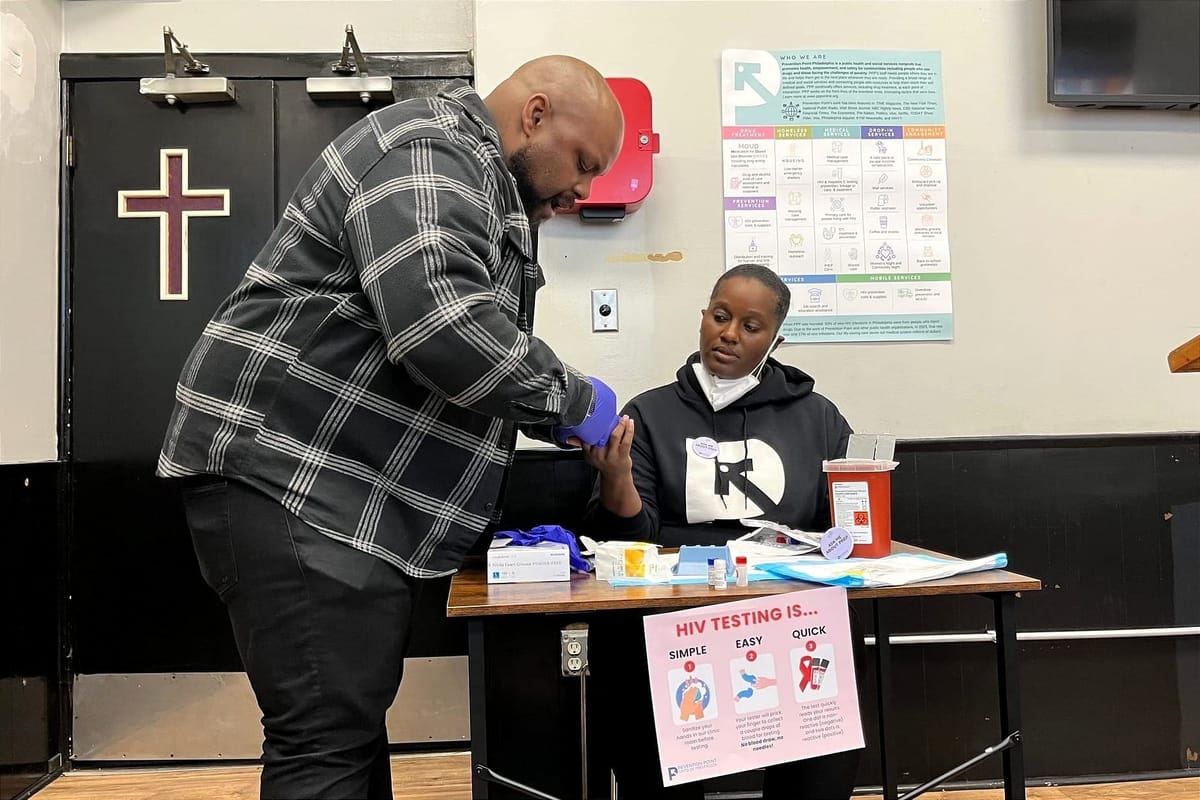
Today, rapid finger-prick tests can deliver results in about 60 seconds. Mims demonstrated the process Friday with Prevention Point health care worker Monica Hillard, using a pinprick to collect a few drops of blood for the test.
Client Mark Knox also shared his experience with Prevention Point. Knox, who formerly used drugs and was diagnosed with HIV while incarcerated, sought help from the organization after his release.
“They treated me whole,” Knox said, later adding that his case managers “gave me everything I asked for, [and] directed me to pathways to help myself.”
Knox spent four years working at Prevention Point and remains active in the community. He said he has connected hundreds of people to the organization’s services and tries to deter people from using drugs while acknowledging that he once resisted help himself.
“These people will help us,” Knox told attendees. “All’s you gotta do is ask.”
HIV testing and prevention tools are free at the corner of East Monmouth Street and Kensington Avenue, where Prevention Point is headquartered in a former church.
For more information, visit www.ppponline.org.