After a four-day trial in federal court, a jury found the city violated Louis Jung Jr.’s constitutional right to medical care while incarcerated and awarded the family $1.67 million in damages.
The decision to spare the two schools from proposed closures comes after nearly a month of intense community pushback against the district’s sweeping facilities plan.
PHDC President David Thomas (left), Mayor Parker's Chief of Staff Tiffany Thurman (center) and Mark Dodds, of the city's Department of Housing and Community Development, testify during a hearing about the H.O.M.E. initiative Wednesday, Dec. 10. (Photo by Jack Tomczuk)
City Council on Wednesday advanced an updated $800 million bond measure for Mayor Cherelle Parker’s housing program that the mayor’s top deputies say she will not support.
The rupture between legislative leaders and the Parker administration over who should be able to qualify for certain forms of housing assistance could derail the Housing Opportunities Made Easy, or H.O.M.E., plan, the mayor’s initiative to build or preserve 30,000 units of affordable housing over four years.
Lawmakers granted preliminary approval to the bond bill, and a companion resolution detailing H.O.M.E.’s $277 million first-year budget could receive a final vote as early as Thursday.
Both pieces of legislation incorporate provisions prioritizing those of more modest means. The budget resolution mandates that 90% of the money for two popular programs – Basic Systems Repair and Adaptive Modifications – be directed to residents earning no more than 60% of area median income.
Parker has proposed raising the current income eligibility for BSRP and Adaptive Modifications from 60% of AMI to 100%.
AMI is set on a metropolitan basis, meaning higher incomes in suburban counties drag up the metric. For a single person, 100% AMI is set at $83,600, and the number is just under $120,000 for a family of four, according to the website for the city’s Department of Housing and Urban Development. 60% AMI is $50,160 for an individual and $71,640 for a four-person household.
Tiffany Thurman, Parker’s chief of staff, urged lawmakers on Wednesday to remove a clause in the bond ordinance that gives Council authority over AMI guidelines or amend it to cover no more than 60% of funding for a particular benefit.
“Boiling individuals down to just their income ignores the real-life, lived experience of everyday, working-class Philadelphians,” said Thurman, adding that AMI does not account for debt and other factors.
One in three city employees, equivalent to about 9,000 households, make between 60% and 100% AMI, which would exclude them from the bulk of the funding, Thurman said.
“H.O.M.E. is not only a housing program,” she added. “It’s also a recruitment tool to attract and retain City of Philadelphia employees.”
“I hope one day we get to the point where our city workers are getting paid enough where they don’t have to sign up,” responded Council President Kenyatta Johnson.
Although Thurman asserted that Council’s change “effectively caps” eligibility at 60%, Councilmember Jamie Gauthier stressed that the legislation does expand income limits while ensuring that 90% of the money goes to those who need it most.
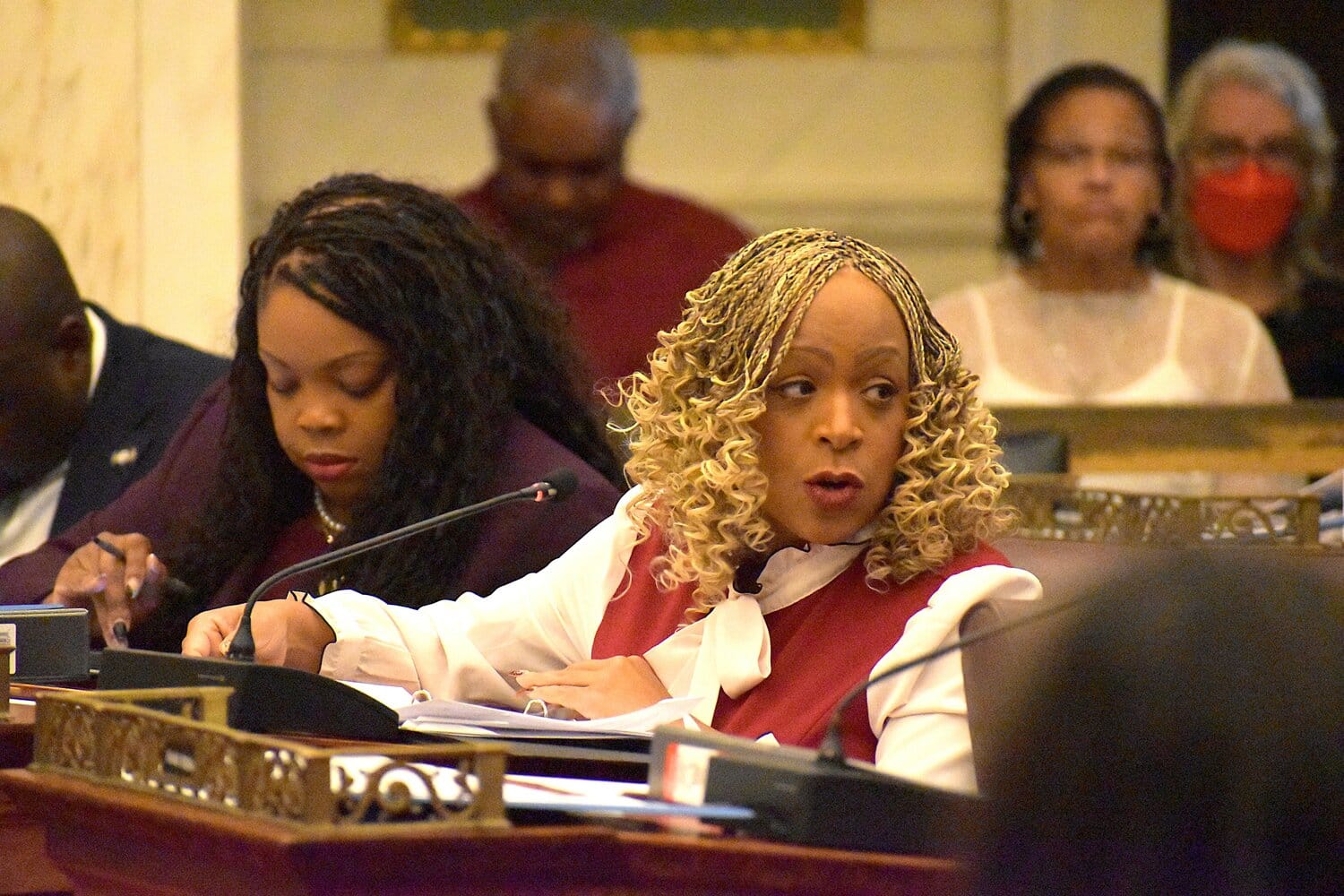
City Councilmember Jamie Gauthier speaks during a hearing about the H.O.M.E. bond ordinance Wednesday, Dec. 10. (Photo by Jack Tomczuk)
Data from Gauthier’s office shows that the average income exceeds 60% AMI in only two of the city’s 10 geographic Council districts.
She noted that the 10% figure for middle-income families came from the Parker administration’s own projections about the increase in applications they expected to receive by easing the salary restrictions.
“To hear people claim that this body is pitting higher income folks against working families, it’s really hard to tell if this is a misread of the facts or a deliberate attempt to misinform,” said Gauthier, Council’s housing committee chair.
Lawmakers moved the bond ordinance out of committee in a 13 to 3 voice tally, with Curtis Jones Jr., Anthony Phillips and Brian O’Neill voting ‘no,’ according to legislative officials.
Jones, after the vote, questioned why Council did not formally consider an amendment requested by the Parker administration’s position. Johnson indicated he had not seen any proposed changes; the amendment document was apparently not circulated until 90 minutes after the hearing started, Council officials said.
Parker, in a statement Wednesday afternoon, noted that the amendment was not introduced and vowed that her “mission won’t change.”
“The whole debate over income eligibility limits for BSRP and Adaptive Modifications is to make sure that we leave no working Philadelphian and no qualifying Philly rowhome owner excluded from these vital programs,” she said. “That includes city employees too. We have a duty and a responsibility to them.”
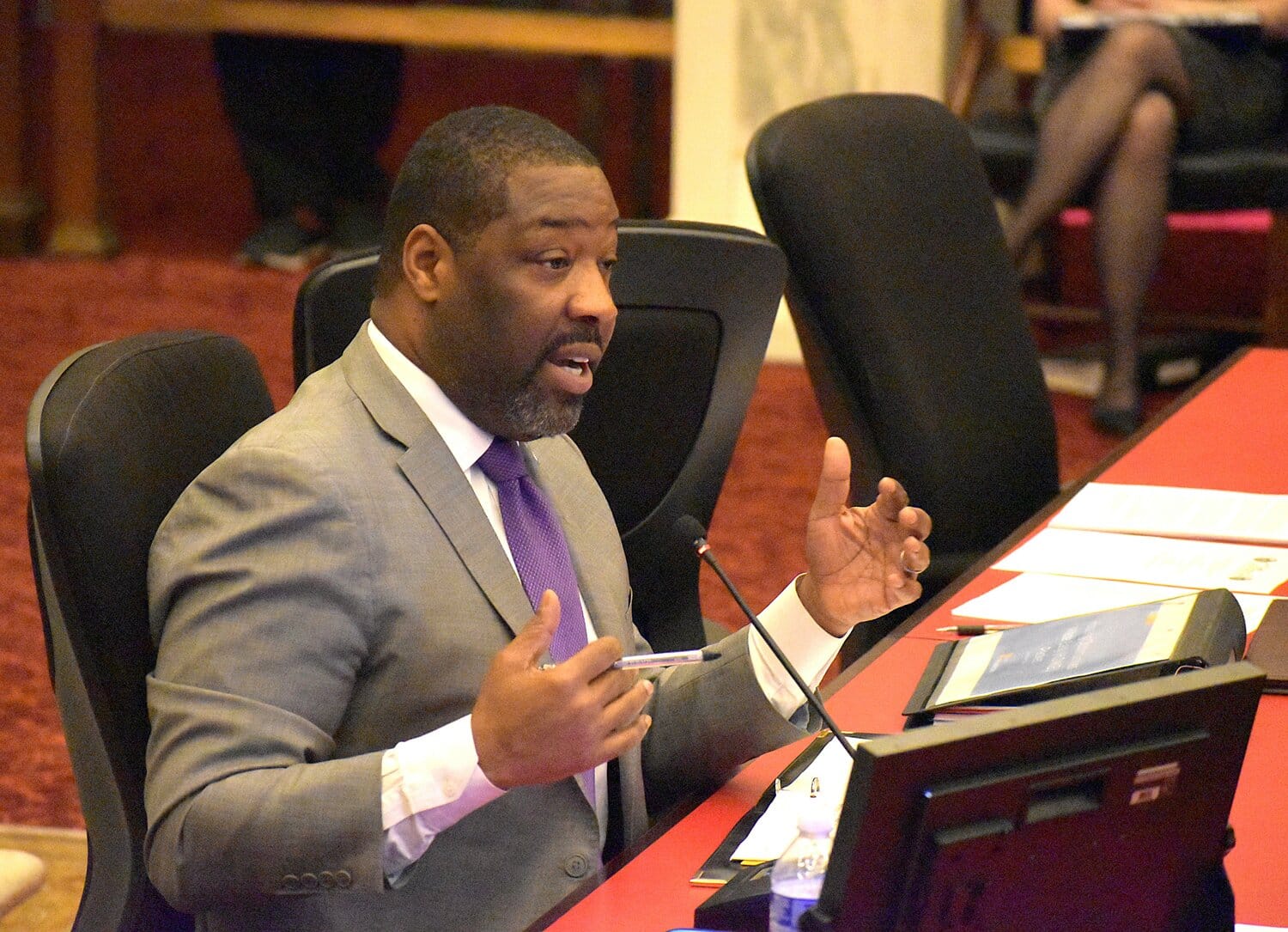
City Council President Kenyatta Johnson speaks during a hearing about the updated H.O.M.E. initiative bond ordinance Wednesday, Dec. 10. (Photo by Jack Tomczuk)
Thurman also asked lawmakers to delay a vote on the budget resolution so that it can be considered alongside the bond ordinance, which, per Council rules, cannot come up for final approval until the body returns from its holiday break in late January.
Representatives from the mayor’s team had previously expressed frustration with what they perceived as Council’s sluggish movement on H.O.M.E.
It was not clear Wednesday whether lawmakers would move to vote on the budget resolution Thursday. Go to metrophiladelphia.com for updates.
Wednesday’s committee hearing featured a rare floor debate among legislators, with advocates in attendance for both sides cheering and jeering at times.
Councilmember Quetcy Lozada, whose 7th District covers sections of Kensington, Frankford, Hunting Park and adjacent neighborhoods, said the vast majority of her constituents earn less than 60% AMI.
“Taking care of ‘the least of these’ first does not mean we stop caring about everyone else,” she said. “It means we start where the need is greatest and build from there.”
Jones, of the West and Northwest Philadelphia-based 4th District, pointed out that anyone newly qualifying for BSRP and Adapted Modifications under the expanded income guidelines would be at the end of lengthy waiting lists for the first-come, first-serve programs.
“At least allow them to get in line,” he commented.
The dispute has become unusually political for a rather technical policy difference. Parker promoted her point of view during a church tour over the weekend, and her team has recruited the support of Democratic Party ward leaders.
“We support the mayor’s 60-40 plan because, again, it has to support homeowners who have been left out, and it seems as if, somewhat punished for working,” testified Gregory Benjamin, leader of Southwest Philadelphia’s 51st Ward. “For having jobs. For being to sustain ourselves but not able to make repairs to our homes because we don’t qualify for various programs.”
Kensington Voice is publishing this story thanks to a collaboration with Metro Philadelphia, a free daily newspaper that publishes citywide.
After a four-day trial in federal court, a jury found the city violated Louis Jung Jr.’s constitutional right to medical care while incarcerated and awarded the family $1.67 million in damages.
The decision to spare the two schools from proposed closures comes after nearly a month of intense community pushback against the district’s sweeping facilities plan.
The Kensington Tigers, representing four Kensington area high schools, opened the season with 13 straight wins while building a new team culture and boosting school morale.