After a four-day trial in federal court, a jury found the city violated Louis Jung Jr.’s constitutional right to medical care while incarcerated and awarded the family $1.67 million in damages.
The decision to spare the two schools from proposed closures comes after nearly a month of intense community pushback against the district’s sweeping facilities plan.
Ashley Jenkins with her son, Syncere Clark Williams, and daughter, Lailah Hall, at Syncere's Conwell Middle School graduation. (Photo courtesy of Ashley Jenkins)
Ashley Jenkins plans to send her two-year-old daughter to Conwell Middle School in Kensington. Two of her sons graduated from the school, and another is in sixth grade.
“It's a safe haven,” Jenkins said. “Conwell is not only a school to us. The teachers are their aunts and uncles … I can’t imagine losing Conwell.”
But that plan may now be upended.
The School District of Philadelphia announced on Jan. 22 that Conwell and Stetson middle schools are among 20 schools it plans to close starting in 2027. The timeline for closures remains unclear. Some schools will phase out over several years, while others will close more quickly.
The district also plans to expand Lewis Elkin and William Cramp elementary schools into K-8 schools. Conwell students would be reassigned to AMY at James Martin, on East Ontario and Richmond streets. Stetson students would be phased into Elkin and Cramp. Both middle school buildings would be converted into district swing spaces.
The proposal is part of the district’s long-awaited reorganization plan, driven by declining citywide enrollment and building issues, including asbestos and poor ventilation.
The proposal has drawn opposition from City Council members, parents, alumni, and educators, who see the schools as integral resource hubs and safe spaces in their communities.
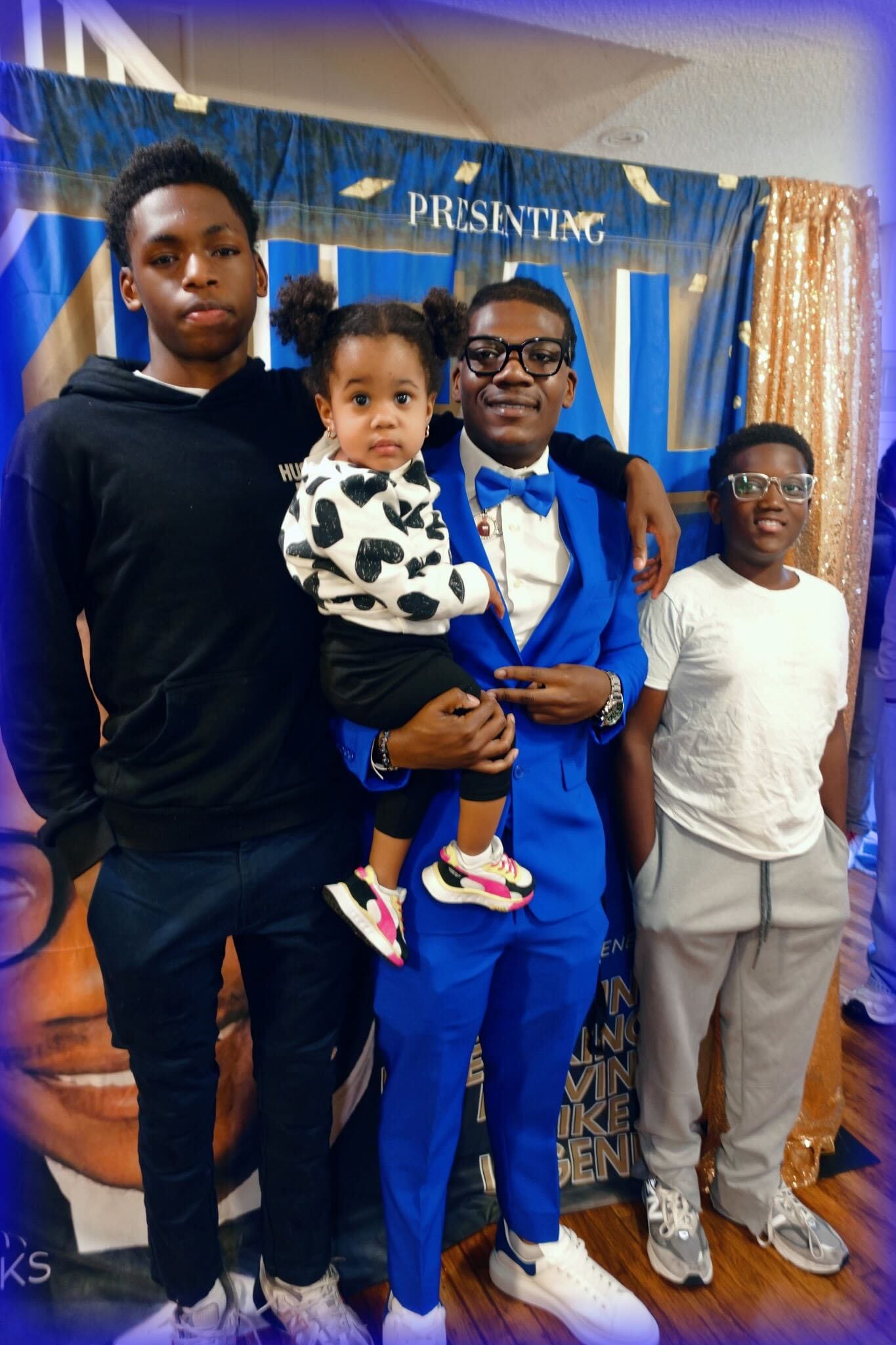
Conwell graduates and brothers Syncere Clark Williams and Rayneal Woods Clark with brother and current Conwell student Yahshua Woods and younger sister Lailah Hall at Rayneal's high school prom in 2025. (Photo courtesy of Ashley Jenkins)
Councilmember Quetcy Lozada, who serves on City Council’s education committee and whose district includes both middle schools, said the announcement caught her by surprise.
To many community members, Lozada said, Conwell is more than school.
“They are part of a family,” she said. “Conwell should not be on that list.”
Conwell operates a food pantry twice a week. Her office just delivered a freezer to the school last week.
The district has cited underenrollment as a reason for the closures, according to Lozada. Districtwide enrollment has declined by about 17,000 students over the past decade, Chalkbeat Philadelphia reported. The drop has been steeper in Kensington: Enrollment at Conwell fell from 176 students in 2022 to 109 in 2025 – a 38% decrease.
While Conwell is a magnet school, more than half of its students live in the surrounding neighborhood.
“The reality is that it's underenrolled because of the neighborhood,” Lozada said. “It’s a public safety issue. It’s not because successful academic learning is not happening there, or that the teachers are not coming anymore, or that the building is falling apart. It’s more about what's happening on the outside. So, instead of responding and making the neighborhood safer, the [students, teachers, and faculty] are being compromised and almost punished.”
Santysha McDuffie said Conwell has supported her family year after year. She picks up Thanksgiving turkeys and winter coats from the school, where her kids are in sixth and eighth grade.
“Whenever we’re having issues, the school is always there to help,” McDuffie said.
McDuffie lives about a 15-minute drive from Conwell and chose the school over other options after researching and receiving a recommendation from a friend for her son, Lawrence.
“He's a smart boy, and he needed a school that was going to keep him on his toes,” said McDuffie, adding that her son has been challenged because he has been assigned high school-level work.
“He's excelling in it, and he loves it,” she said.
McDuffie’s daughter, Madison, is also thriving.
“I know she's safe there,” McDuffie said. “She feels more like herself. She's opening up.”
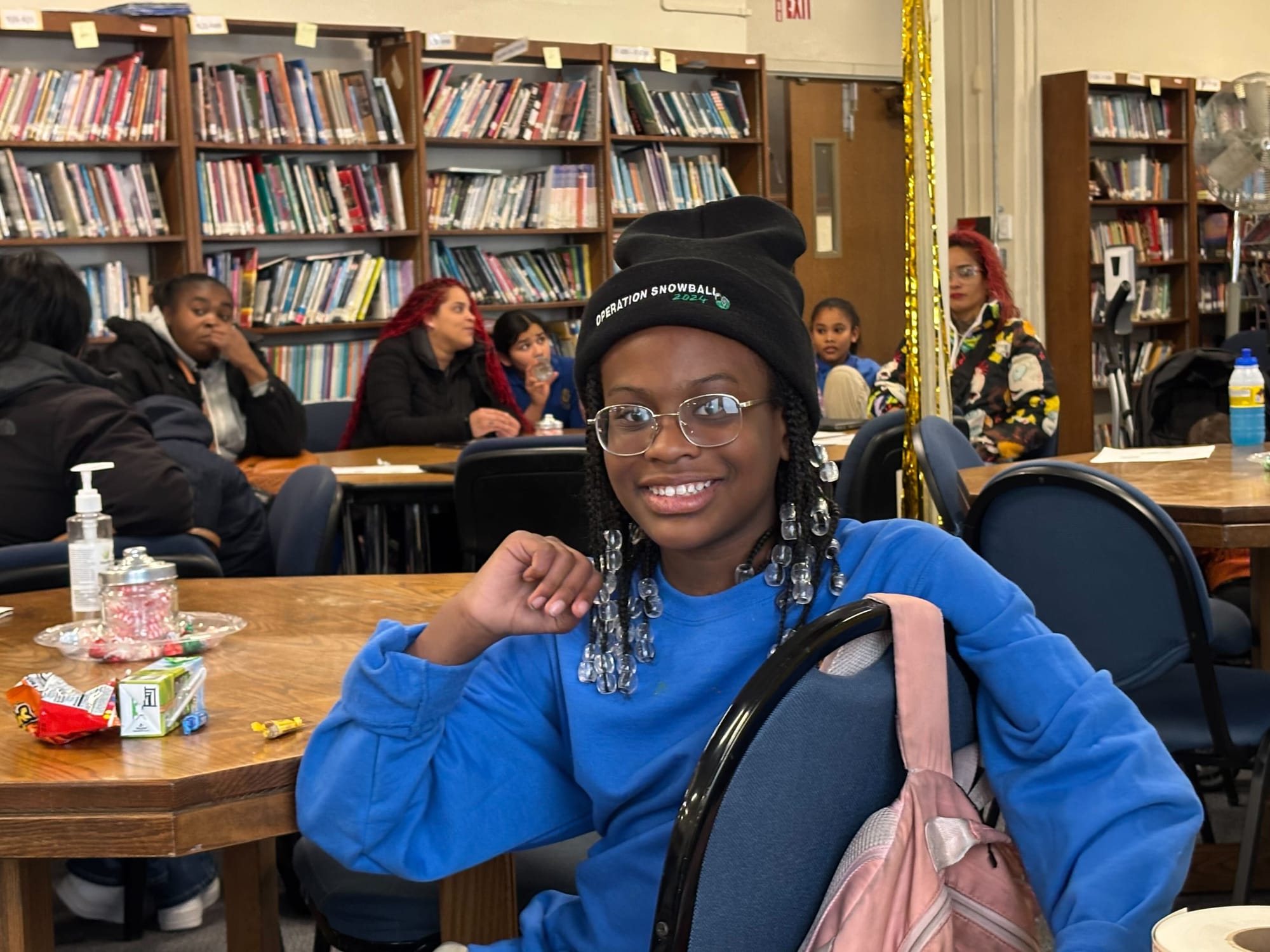
Santysha McDuffie's daughter, Madison, sitting in the Conwell Middle School library, where McDuffie said she likes to spend time. (Photo courtesy of Santysha McDuffie)
Recent investments raise questions about reassignment
The district’s proposal to close Conwell comes after hundreds of thousands of dollars were invested in the school in recent years, raising questions about how the closure aligns with those expenditures.
Conwell was designated $333,333 in opioid settlement funds, one of six Kensington schoolsto receive money from lawsuits against opioid manufacturers and distributors. As of December 2024, about $109,950 of those funds had been allocated for science equipment, including 3D printers, and for after-school programs like the Conwell Media Team. The media lab itself is a recent development. In 2023, the media lab teacher crowdfunded for gear.
Additional opioid funds were designated for a therapeutic space, student support amenities, and schoolyard improvements, including space for an outdoor farming program, and a washer and dryer for students’ clothes.
Separately, Principal Erica Green used a $20,000 Lindback Award she received in 2022 to upgrade the school's science lab and expand STEAM programming.
Meanwhile, the school opened a new turf soccer field in 2024.
The proposed reassignment of Conwell students to AMY at James Martin also raises questions about how the district is applying its own school rankings, which are part of its decision-making process. The district ranked the building, programming, capacity, and neighborhood vulnerability for every school it operates in the city.
According to district data, AMY’s building is rated poor and its programming unsatisfactory. Conwell received higher rankings in both categories, with its building and programming classified as fair.
Superintendent Tony Watlington said during a press conference last week that no students would be moved into buildings rated poor or unsatisfactory. He also said that 90% of students would be reassigned to schools with comparable or better academic outcomes.
The district's plan also calls for modernizing 159 school buildings, but it has not provided details on how those upgrades would affect schools slated to remain open, including AMY.
The district did not respond to a request for comment regarding this reassignment in time for publication.
Stetson, another “neighborhood fixture”
A majority of Stetson Middle School students live in the surrounding neighborhood. Stetson’s enrollment has declined since the district contentiously revoked the school’s charter status in 2022, after a years-long battle between the Philadelphia Board of Education, families, and the charter company, ASPIRA. Enrollment fell from 616 students that year to 511 in 2025 — a 17% decrease.
The petition raises concerns about potential overcrowding at Elkin and Cramp elementary schools, where Stetson students would be reassigned. The district has labeled both schools as underutilized.
“Schools like Stetson serve as community hubs where families connect,” the petition states. “This loss could fragment our closely-knit community and erode social ties.”
Tony Rocco, who taught full time at Stetson for nine years before retiring in 2019, teaches an after-school photography class there twice a week.
“Stetson has become a fixture in the neighborhood,” Rocco said.
While the school has had its challenges, Rocco said he has watched generations of families pass through, and has seen students like Benny Martinez-Russi flourish.
Martinez-Russi, 19, graduated from Stetson and is now a first-year student at Temple University on a full academic scholarship.
“If I drive past the area, I’m gonna feel nostalgia,” Martinez-Russi said.
He was quiet when he started there, but teachers, including Rocco, whom he described as a father figure, helped him warm up.
“I see the good work that gets done in that school every day and the difference that every teacher tries to make for their kids,” Rocco said. “It breaks my heart to see Stetson and the parents, potentially again, having to go through yet another bunch of changes.”
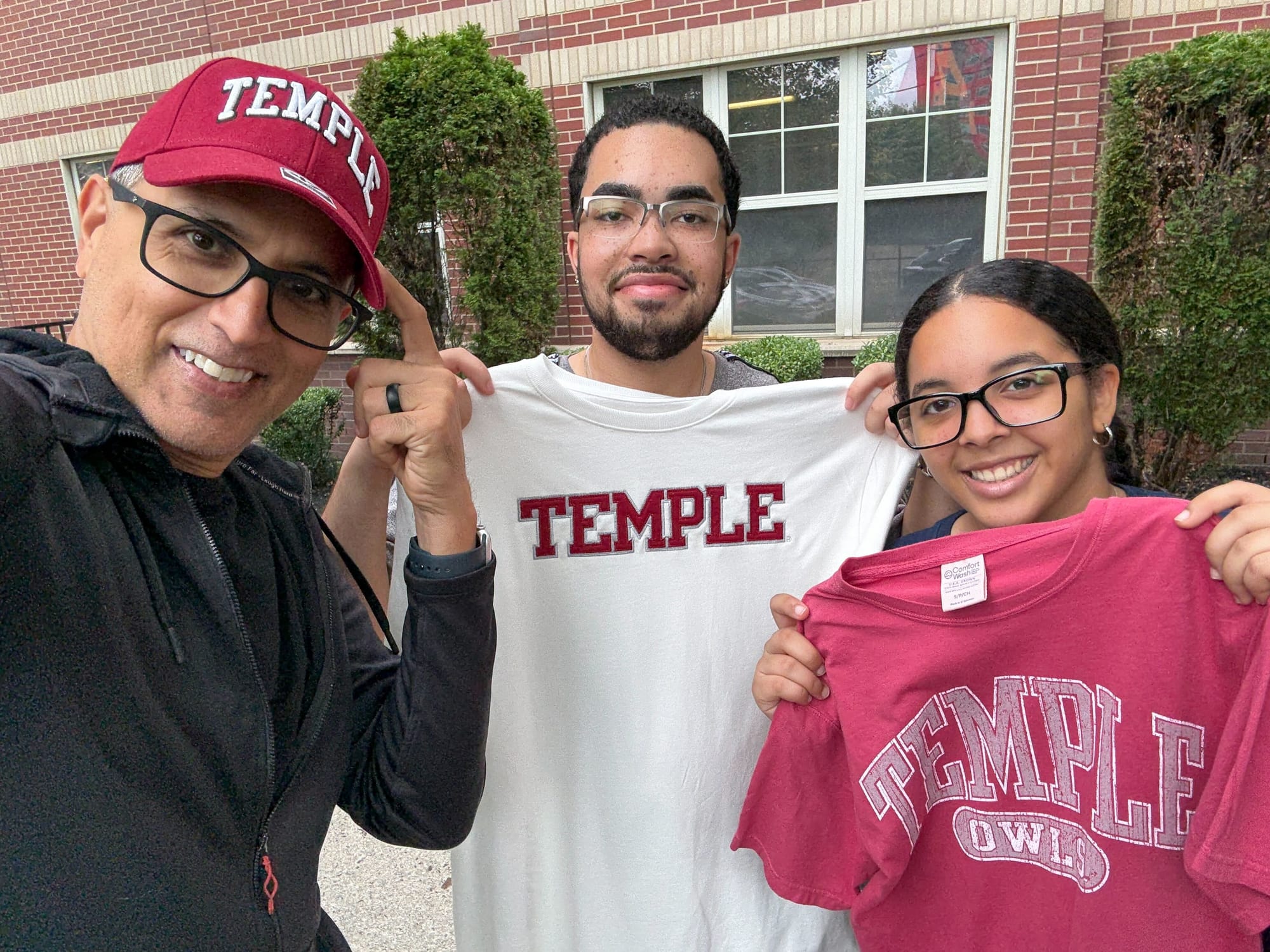
Photography teacher Tony Rocco (left) with Benny Martinez-Russi (middle), a Stetson Middle School alum and now Temple student. (Photo courtesy of Tony Rocco)
District data show Stetson’s building faces bigger structural challenges than Conwell. Stetson’s building was rated unsatisfactory, with a score of 41%, and its programming received a score of 25%. The neighborhood’s vulnerability score was flagged as “high risk.”
The district defines high neighborhood vulnerability as places with many social and economic challenges, including those that may have experienced school closures in the past.
A state hearing officer’s report found that ASPIRA made progress improving Stetson’s climate but fell short on academic and financial promises. A charter appeal board voted 4-1 to revoke the school’s charter status in 2022, about three years after the school board voted to not renew ASPIRA's contracts.
“I just hope that they're thinking through, as much as possible, about the decisions that they make,” Rocco said. “Do you have a better plan for Stetson, or is this something that is just dollars and cents in a spreadsheet, where you're trying to figure out how to save money? Because those are my kids.”
More changes nearby
In Norris Square, the district plans to close John Welsh Elementary. The district rated the building as poor.
Under the proposal, Welsh students would be reassigned to John Hartranft and William McKinley elementary schools. The plan is to modernize and repurpose the Welsh building into a year-round high school.
In Frankford, the district wants to close Warren G. Harding Middle School. The James J. Sullivan School, John Marshall School, Henry W. Lawton School, and Laura H. Carnell School would expand, with Sullivan moving into the Harding building.
In Fishtown, Penn Treaty High School would also close.
Councilmember Jeffrey Young, whose district includes Penn Treaty, said the district told him Penn Treaty students would be phased into a high school in the Kensington catchment area. William Bodine High School would move into Penn Treaty’s building to expand capacity.
What’s next?
Education Committee Chair Isaiah Thomas will meet with every council member to discuss proposed closures and community needs, Lozada said.
Then, she said the education committee will review each council member’s priorities and bring them to the school board and the district.
Lozada said she will host community meetings to gather feedback. The district has also scheduled community engagement sessions for every school slated for closure throughout February.
“I would want none of them to close, but if we have to close them – if we can't get to a point where we can't save them – then I want the transition to be as easy and as safe as possible, not just for our children, but for our teachers,” Lozada said.
According to the district, teachers and staff affected by the plan should retain their jobs. Chalkbeat reported that principals in “good standing” would also be retained.
The district’s recommendations will be presented to the Philadelphia Board of Education on Feb. 26.
“Any changes in information that we have shared will be provided at that time,” said district spokesperson Monique Braxton in response to a request for comment.
The school board must approve the final plan and may make changes.
Emily Rizzo is the Accountability Reporter for Kensington Voice. She mostly covers the city’s response to the opioid and housing crises in Kensington, with a focus on how new policies and initiatives affect the community.
After a four-day trial in federal court, a jury found the city violated Louis Jung Jr.’s constitutional right to medical care while incarcerated and awarded the family $1.67 million in damages.
The decision to spare the two schools from proposed closures comes after nearly a month of intense community pushback against the district’s sweeping facilities plan.
The Kensington Tigers, representing four Kensington area high schools, opened the season with 13 straight wins while building a new team culture and boosting school morale.